

As extreme heat becomes a defining challenge for the UK’s built environment David Cheshire, sustainability director at AECOM, argues that towns and cities must be redesigned to reflect, shade and cool — protecting people, infrastructure and productivity from the rising risks of climate change
Having already sweltered through three heatwaves this summer, the UK will have to brace itself for more tropical nights and suffocating days in the years ahead as they increasingly become part of daily life.
The high temperatures are not just uncomfortable and inconvenient – they also have an impact on our productivity, infrastructure, critical services and, unfortunately, on our health and wellbeing. The heat was responsible for more than 14,000 excess deaths across Europe in June and July, with more than 150 million people impacted.
Some may have seen images of the staff in St Mary’s Hospital hosing down the heat rejection plant to keep the chillers running, keeping an essential building in operation. Scenes like these, amid the kind of periods of heat we’ve just experienced, can be easy to dismiss – but they might not be for much longer.
Heatwaves in the UK have typically been fleeting and over with within a few days, but we now know that they are becoming more frequent and intense with each year that passes.
Not built for this
In the UK, our cities were never designed for this heat. We have dark, absorbent surfaces; large areas of glazing and a lack of shading on our streets and buildings.
With our buildings absorbing and trapping heat during the day, it is then re-radiated at night, making our nighttime hours nearly as hot as those during daylight. As well as disrupting sleep, this means we cannot cool down the fabric of our buildings – and so heat continues to build up each day.
As a result, the combination of rapid temperature rises, high humidity and lack of air movement make the heat particularly hard to handle. Our bodies are not given the chance to adapt and our built environment is ill-equipped to protect us, leading to serious heat-stress that impacts us all, but hits the elderly and vulnerable the hardest. The poorest neighbourhoods are typically also the least well equipped, often lacking green infrastructure and open spaces, along with the resources to adapt.
Contrast the UK’s buildings with those designed for the heat – in southern Spain, for example, many buildings have white walls, external shutters, inwardly opening windows and concrete walls with tiled floors providing exposed thermal mass.
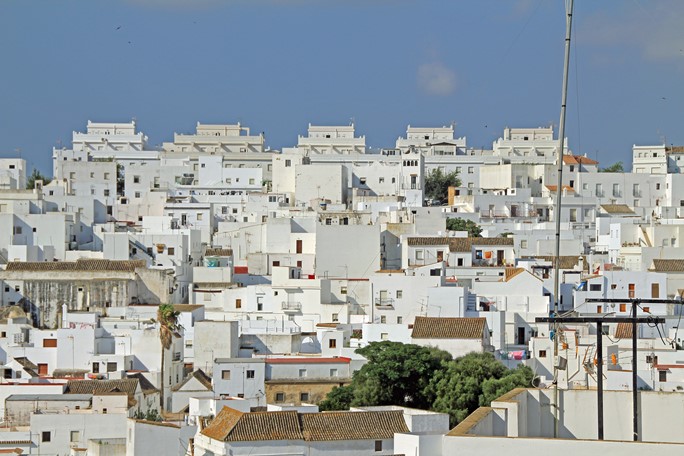
If we are to meet this challenge, we will need to adapt our towns and cities to follow similar measures. This will likely require changes at every scale, from city-wide through to individual building adaptations. At the masterplan level, we can centre this across three principles – the UK will have to considerably upscale our use of lighter coloured surfaces to reflect heat, create more shading and ‘cool routes’ through the public realm and finally increase our ability to keep our buildings cool internally.
How we beat the heat
We can start defending our buildings against intense solar gain by painting walls and roofs white, and by adding shading to protect both the glazing and the building fabric. Highly-reflective paints have been developed for just this purpose, while external shading can be retrofitted using awnings, solar sails and parasols – and those trying to keep their apartments cool could even hang sheets outside their windows.
Crucially, as many will have learned over the course of this summer, closing curtains and internal blinds during the day is simply too little too late, as the heat has already entered the room. Since reflected light changes wavelength, it cannot and will not escape back through the glass – this is what the greenhouse effect was named after.
To combat this, new buildings will need to be better orientated to avoid large areas of south-west-facing glazing, with larger overhangs and external shading built in. External shading is often seen as too expensive and therefore not added to flats and apartments, but this will have to be reconsidered, along with ceiling-mounted fans and tiled floors.
When it comes to green infrastructure, we will need to plant more trees and add in more greenery to take advantage of the natural shading they provide alongside the cooling effects of evapotranspiration.
Currently, however, existing planting is under threat in the UK, with increasing drought and heat stress killing off many street trees and green areas. To combat this growing challenge, we will have to choose heat and drought-resistant plants, providing them with access to soil rather using planters and tree pits, and irrigate, ideally with stored rainwater.
By necessity, we’re also going to see air conditioning becoming more common throughout the UK, which will be essential for vulnerable people. However, this will also create further challenges, dumping more heat into the local environment while also using more energy, adding to national carbon emissions. Making greater use of passive measures will help to reduce the amount of air conditioning we need, and so should be prioritised where possible.
A greater proportion of non-domestic buildings will also need to be air conditioned, including small retail units and local offices, alongside more passive measures to protect against solar gain. We may also need to formalise the creation of cool spaces for vulnerable people to find respite from the heat, just as we have been creating ‘warm banks’ in cold winters to help combat the cost-of-living crisis.
Finally, the UK will also need to consider how we occupy our buildings. In the future, we might need to start earlier in the day and introduce siestas, reconvening later in the afternoon. Similarly, we might vacate our major cities during intense heatwaves, in the way that those that can will vacate Madrid and Athens in August to escape to the mountains or the islands, respectively.
The true cost of a cooler city
The cost of adaptation will likely be high, but a study by the Nature Conservancy and AECOM found that rising heat in Phoenix, Arizona, could cost hundreds of lives and billions in lost economic output annually. The report also showed that increasing tree cover from 13% to 25% through the widespread planting of desert-adapted trees could save around $15bn between 2020–2059, reducing deaths and lowering healthcare, infrastructure and productivity costs.
We will need to take care to ensure that the resources we direct to climate adaptation go as far and achieve as much as they possibly can, but the real cost we need to wake up to is that of not taking greater action – even in the face of this summer’s warning signs.
What’s clear, however, is that the events of this summer have shown that the UK needs to treat intense heat as a design criterion, integrating measures into every decision about our built environment. We mightn’t be able to beat the heat, but we can certainly try to roll with the punches.
News categories: Infrastructure Intelligence
- Share this page
-

-


